
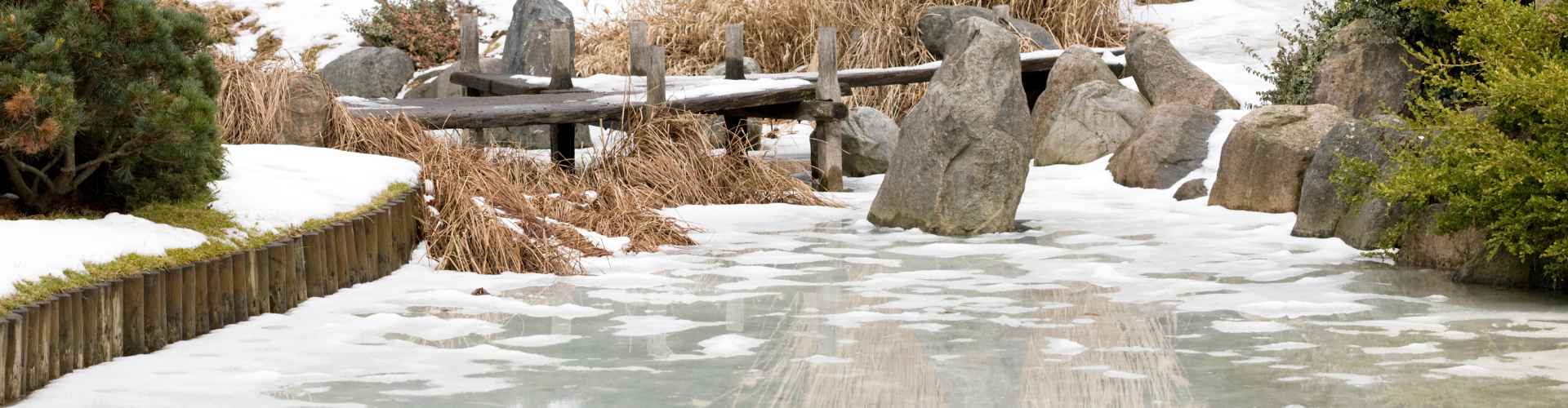
As the nights draw in and the temperature drops, your pond changes completely. Koi, goldfish and other pond fish slow right down over winter, and the way you care for them needs to change too.
The good news is that healthy pond fish are very well suited to a British winter. With a few simple steps now, you can make sure your fish come through the cold months happy and ready for spring.
In this guide, our team at Universal Aquatics covers when to stop feeding your pond fish, how to stop your pond freezing over, and what to do with your pumps, filters and plants.
When should you stop feeding pond fish?
Pond fish are cold blooded, so their metabolism slows as the water cools. In cold water they cannot digest food properly, and uneaten food rots and pollutes the pond. That is why the water temperature, not the date, should decide how you feed.
The simplest way to keep track is with a floating pond thermometer. Check it regularly, ideally in the morning when the water is at its coldest.
Why wheatgerm food?
Wheatgerm based foods are lower in protein and much easier for fish to digest in cool water. A food such as Tetra Pond Wheatgerm Sticks is ideal for autumn and early spring, when temperatures sit between 5°C and 10°C.
Only give as much as your fish will eat in a few minutes, and scoop out anything left over.
Don’t worry if your fish stop eating
It is completely normal for koi and goldfish to go weeks without food in winter. They rest near the bottom of the pond, where the water stays slightly warmer, and live off their reserves. Feeding them in very cold water does more harm than good.
How to stop your pond freezing over
A layer of ice on its own won’t harm your fish. The problem is a pond that freezes over completely. Waste gases from fish and rotting leaves get trapped under the ice, and fresh oxygen can’t get in.
The aim is to keep at least one small area of the surface free of ice all winter.
Never smash the ice
It is tempting to break the ice with a hammer or spade, but please don’t. The shock waves travel through the water and can stress or even harm resting fish.
Instead, gently melt a hole by standing a pan of hot water on the ice. Never pour boiling water straight into the pond.
Use a floating ice preventer or pond heater
A floating ice preventer or small pond heater keeps a hole open automatically, even during a hard frost. It is one of the easiest ways to protect your fish, especially if you are away or can’t check the pond every day.
Keep the water oxygenated
An air pump with an air stone adds oxygen and the movement at the surface helps stop ice forming. In winter, raise the air stone so it sits nearer the surface rather than on the bottom. This avoids mixing up the slightly warmer water at the bottom, where your fish are resting.
Pumps, filters and UV clarifiers in winter
Pumps: if your pump sits at the deepest part of the pond, raise it up onto a shelf or block. This stops it churning up the warmer water at the bottom. Waterfalls and streams can chill the water further, so many pond keepers switch these off for winter.
Filters: where possible, keep your filter running through winter. The good bacteria living in it break down fish waste, and they take weeks to build back up if the filter is switched off. If you do turn it off, clean it before restarting in spring.
UV clarifiers: green water is rarely a problem in winter, so you can switch your UV clarifier off to save energy. Spring is a good time to fit a new UV bulb, as they lose their strength over time even when they still light up.
Keep leaves and debris out
Falling leaves are one of the biggest winter risks to a pond. As they rot, they release harmful gases and use up oxygen, which is exactly what your fish need most when the surface freezes.
- Fit a pond net over the surface during autumn to catch leaves before they sink.
- Scoop out debris that has already settled, using a pond net, before the weather turns really cold.
- Cut back pond plants, trim dying leaves from water lilies and marginal plants so they don’t rot in the water.
- Leave the fish in peace, avoid big clean outs or large water changes in winter, as these can disturb and stress resting fish.
Your winter pond checklist
- Put a floating thermometer in the pond
- Switch to wheatgerm food when the water drops below 10°C
- Stop feeding when the water drops below 5°C
- Net the pond to catch falling leaves
- Remove dead leaves and trim back pond plants
- Raise the pump and air stone off the bottom
- Keep the filter running if you can
- Switch off the UV clarifier, waterfalls and streams
- Fit a floating ice preventer or pond heater
- Never smash ice on the pond
Frequently asked questions
Can koi survive in a frozen pond?
Yes, as long as the pond is deep enough and a hole is kept in the ice. Koi rest near the bottom, where the water stays warmer. A depth of at least 1 metre in part of the pond is a good guide for koi.
Do goldfish need feeding in winter?
No, not once the water drops below 5°C. Like koi, goldfish slow down and live off their reserves until spring.
Should I turn my pond pump off in winter?
Not necessarily. Keeping the filter and pump running helps protect the good bacteria. Just raise the pump off the bottom, and switch off waterfalls that chill the water.
When can I start feeding my pond fish again?
When the water warms back above 5°C in spring, start with small amounts of wheatgerm food. Move back to a normal food once the water is consistently above 10°C.
Get your pond ready for winter with Universal Aquatics
With over 30 years of combined experience, our team is always happy to help you prepare your pond for the colder months. From wheatgerm food and air pumps to pond nets and treatments, we stock everything you need to keep your koi and goldfish healthy until spring.
Visit us in store at Unit 46 Imex Business Park, Ormonde Street, Fenton, Stoke-on-Trent, ST4 3NP, call us on 01782 438 004, or shop our full Pond and Koi range online with UK delivery.